



Effektive Qualitätskontrolle von Stahl- und Eisenprodukten mittels Verbrennungsanalytik
Der Elementgehalt von Kohlenstoff (C), Schwefel (S), Wasserstoff (H), Stickstoff (N) und Sauerstoff (O) in Eisenprodukten, wie z. B. Stahl, hat entscheidenden Einfluss auf Materialeigenschaften wie Duktilität, Sprödigkeit oder Härte. Die zuverlässige Bestimmung des C, H, N, S, O Gehaltes ist daher eine Routineaufgabe in der Qualitätskontrolle in der Stahl- und Eisenproduktion. Dieser Artikel untersucht, welche Einsatzmöglichkeiten und Vorteile Elementaranalysensysteme, die auch als Verbrennungsanalysatoren bezeichnet werden, in diesem Bereich haben.
Elementaranalyse von Metallpulvern für die Additive Fertigung
Die Additive Fertigung entwickelt sich zu einem etablierten Produktionsverfahren. Da es sich um eine recht neue Technologie handelt, sind die nötigen Prozessschritte noch nicht einheitlich etabliert. So fehlen z.B. industrieweite Standards, welche die Qualitätssicherung beschreiben. Eine bekannte Kenngröße ist die Partikelgrößenverteilung des eingesetzten Pulvers. Die Korngröße sollte aber nicht das einzige zur Überprüfung verwendete Qualitätsmerkmal sein. Zu den im Prozess verwendeten Ausgangsstoffen gehören u. a. unterschiedliche Stahl- und Titansorten. Um die Reinheit und die Qualität dieser Rohmaterialien zu überprüfen, müssen geeignete Prozesse implementiert werden.

Möglichkeiten der normgerechten Elementanalyse von Siliciumcarbid und Siliciumcarbid enthaltenden Mischungen mit Verbrennungsanalysatoren
Elementanalysatoren leisten einen wichtigen Beitrag zur Qualitätssicherung vieler Produkte. Unterschiedlichste Matrizes wie Keramiken, Kohle, Stahl und Böden können mit verschiedenen Instrumenten auf ihren Elementgehalt hin untersucht werden. <b>Die ELTRA GmbH mit Sitz in Haan bietet mit ihren Analysatoren für C, H, N, S, O und Thermogravimetrie die Möglichkeit, Kohlenstoff in unterschiedlichen Bindungsformen sowie auch Sauerstoff und Stickstoff in SiC und SiC enthaltenden Stoffen umfassend und normgerecht zu bestimmen.</b> Je nach gewünschtem Parameter sind jedoch sehr unterschiedliche Anforderungen für eine normgerechte Analyse zu erfüllen.
Carbon & Sulfur Determination in Steel Plants and Foundries
Different methods are applied to measure C/S concentrations in steel, iron-based products, or in typical foundry products, such as ferro chromium. Among them are multi-element techniques like spectrometry or specialized carbon/sulfur analysis.

Fast and reliable C and S determination with elemental analyzers - a useful addition to XRF
Part of the production process of high quality cement is quality control of the raw materials as well as the intermediate and finished products. At each production stage samples are taken, processed and analyzed to determine the chemical composition of the material. For the fast, accurate and reliable determination of carbon and sulfur elemental analyzers using combustion technology are a useful addition to XRF analyzers. Apart from size reduction no further sample preparation is needed for analyzing a sample with an elemental analyzer. In contrast to XRF analysis the element content of carbon and sulfur can be measured from the ppm range up to 100 % and the results are usually obtained within 60 to 120 seconds.
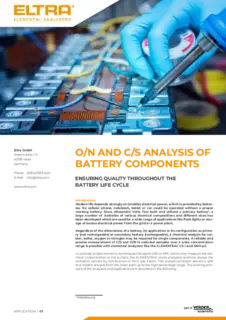
O/N and C/S Analysis of Battery Components
Regardless of the dimensions of a battery, its application or its configuration as primary (not rechargeable) or secondary battery (rechargeable), a chemical analysis for carbon, sulfur, oxygen or nitrogen may be required for single components. A reliable and precise measurement of C/S and O/N in selected samples over a wide concentration range is possible with elemental analyzers like the ELEMENTRAC CS-i and ONH-p 2.
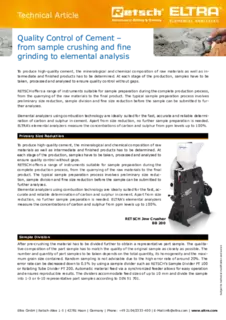
Quality control of cement
Elemental analysers based on combustion technology are a useful addition to XRF analysis for the quality control of cement and related products, ensuring fast, precise and reliable determination of carbon and sulphur. With its offering of analyzers using resistance or induction furnaces or both, ELTRA covers a wide range of applications for C and S determination in organic and inorganic samples. The product range is ideally suited to the variety of analytical applications in a cement plant.
Standard-compliant element analysis of silicon carbide and mixtures containing silicon carbide with combustion analyzers
Elemental analyzers are important tools for quality control of a wide range of products. A variety of matrices, such as ceramics, coal, steel or soil, can be analyzed for their element concentrations with different types of instruments. The product range of Eltra GmbH, located near Düsseldorf, Germany, comprises analyzers for C, H, N, S, O and thermogravimetry which allow for the standard-compliant determination of carbon in various chemical bondings, as well as oxygen and nitrogen in SiC and in materials containing SiC. The requirements which have to be fulfilled for a standard-compliant analysis may, however, vary greatly, depending on the desired parameters.